J&K Assembly Session Begins: Omar Abdullah Government Faces Heat Over Statehood, Jobs, Reservation and Power Tariffs
By: News Desk | 20 September 2026
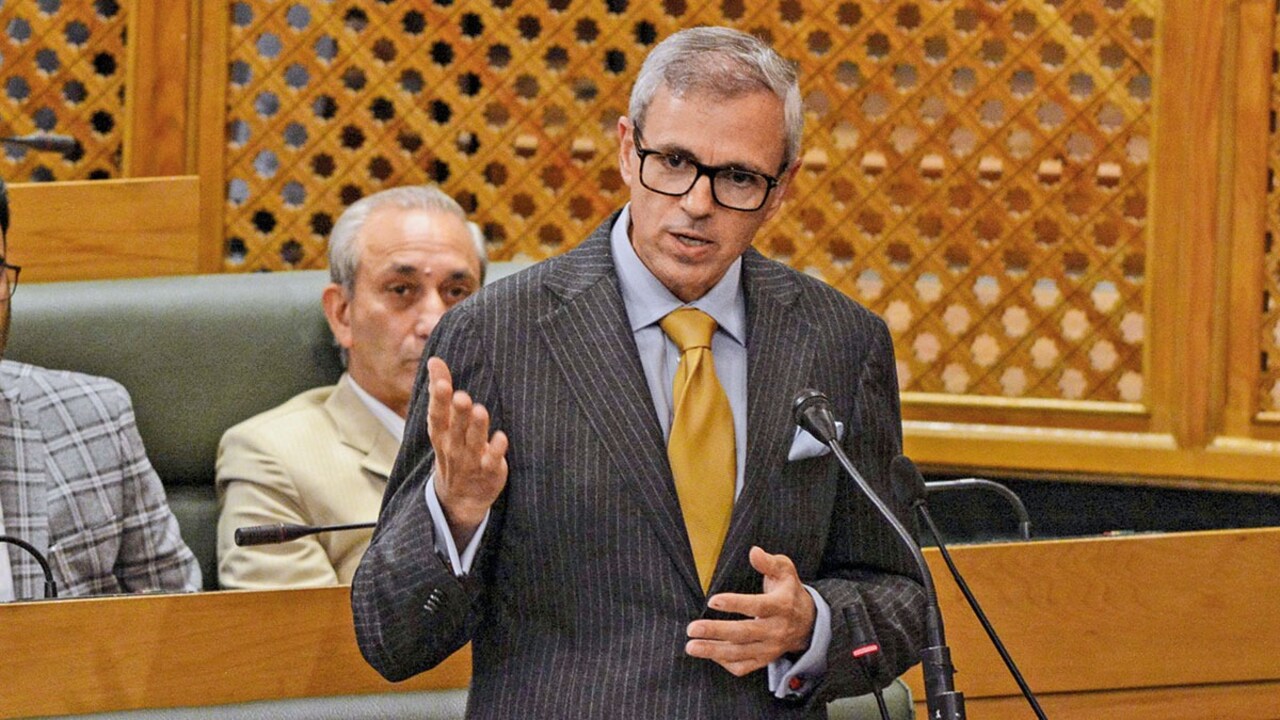
Srinagar: The Jammu and Kashmir Legislative Assembly enters its latest session with the Omar Abdullah government facing a familiar but increasingly complicated political test: how to defend its record on governance while managing disagreements with its own alliance partner and a fragmented opposition.
The autumn session begins on Monday, September 21, and is scheduled to continue until September 30. The official Assembly portal lists it as the sixth session of the Union Territory’s Legislative Assembly. The provisional calendar provides for seven sittings spread across the 10-day period.
On paper, the agenda is legislative. In political terms, however, the session is likely to become a broader examination of the government’s first two years in office.
Unemployment, recruitment, reservation, electricity tariffs, shortages in public services, infrastructure, regularisation of workers and the unresolved demand for restoration of statehood are expected to feature prominently.
But there is another layer to the session.
Congress, which helped the National Conference form the government after the 2024 Assembly election, remains outside the Council of Ministers. The party continues to support the government on issues linked to its stability, while insisting that it will independently raise matters affecting the public.
That arrangement gives the Assembly an unusual political character. The government is not facing opposition only from across the aisle. Some of its most consequential questions are also likely to come from a party that helped bring it to power.
A Session That Comes With a Long List of Public Questions
The scale of the pending business illustrates the pressure on legislators.
According to reports from the Assembly Secretariat, around 650 questions have been received from members, along with roughly 16-17 Private Members’ Bills and nearly 50 Private Members’ Resolutions. The provisional calendar sets aside government business, Private Members’ Bills and resolutions during the session.
The opening day itself is not merely ceremonial.
The House is scheduled to take up a report of the Assembly committee headed by Justice Hasnain Masoodi concerning alleged irregularities in the implementation of the Jal Jeevan Mission in Jammu and Kashmir. A Bill seeking amendments to the Jammu and Kashmir Cooperative Societies Act, 1989, is also scheduled for introduction.
That means the government could face scrutiny from the very beginning over the implementation of public schemes, administrative performance and legislative commitments.
For the opposition, the large question list offers an opportunity to turn individual constituency grievances into a wider discussion about governance.
Congress: Alliance With NC Does Not Mean Silence
The most politically delicate position belongs to Congress.
The party contested the 2024 Assembly election in alliance with the National Conference and continues to support the Omar Abdullah government. But Congress has repeatedly made clear that it does not consider alliance politics a reason to remain silent in the Assembly.
J&K Congress president Tariq Hameed Karra has reiterated that position ahead of the session, saying Congress legislators will raise matters of public importance despite the alliance.
The distinction is important.
Congress is not formally part of the Cabinet. Karra has maintained that his party will not accept ministerial positions until statehood is restored to Jammu and Kashmir. The NC has made attempts to bring Congress into the Council of Ministers, but that condition remains in place.
For Omar Abdullah, this creates an unusual political arrangement.
His government enjoys Congress support, but Congress also retains the freedom to question decisions made by the government.
The electricity tariff issue is a clear example.
Karra has publicly opposed the recent tariff revision and called for its rollback, arguing that consumers should not be placed under additional financial pressure.
The tariff increase itself is not simply a political claim. The Joint Electricity Regulatory Commission approved revised retail supply tariffs for the 2026-27 financial year. Its order provides for implementation from September 1, 2026, and records an average tariff increase of 6.83 per cent. The order also factors in substantial subsidy support from the J&K government.
That distinction matters because the political argument is not over whether a tariff revision exists. It is over whether the increase is justified, affordable and appropriately structured.
Congress is likely to press the government on precisely that question.
Electricity Bills Become a Political Issue
Power has long been one of Jammu and Kashmir’s most sensitive governance issues.
The latest tariff order attempts to balance two competing realities: the financial pressure on distribution companies and the political need to keep electricity affordable for households.
The JERC order approved a revised tariff structure while recognising a government subsidy commitment of about ₹2,420.78 crore. The subsidised tariff was made applicable to consumption from September 1.
This creates a more complicated picture than the simple phrase “power tariff hike” suggests.
For consumers, however, the practical question is straightforward: what will appear on the electricity bill?
Congress has seized on that concern. Karra has also sought an amnesty mechanism for consumers with accumulated electricity dues.
The government, meanwhile, must explain how tariff rationalisation, subsidy support and the financial condition of the power sector fit together.
That debate could become one of the clearest examples of how an administrative decision turns into an Assembly-level political confrontation.
PDP Puts Reservation and Open Merit at the Centre
Another potentially explosive issue is Jammu and Kashmir’s reservation framework.
The PDP has intensified its criticism of the government over what it describes as an unfair balance between reserved categories and open-merit candidates. PDP leader Iltija Mufti has demanded that the government release the report of the Cabinet Sub-Committee constituted to examine and rationalise the reservation system.
The language surrounding the dispute has become increasingly sharp.
PDP leaders have used phrases such as “merit apartheid” and “institutional apartheid” while describing what they see as the impact of the existing framework on open-merit aspirants. Those are political characterisations, not findings established by an official inquiry.
The underlying policy dispute, however, is real.
Jammu and Kashmir’s reservation framework has undergone several changes over the years, including amendments following the reorganisation of the former state. Government recruitment continues to be governed by the applicable Reservation Act and rules, including amendments issued by the Union Territory administration. Official government records confirm the continuing operation of reservation provisions in recruitment.
The political argument is now centred on whether the current distribution provides an appropriate balance between representation for reserved communities and opportunities for candidates competing in the open category.
That is not a question that can be settled by slogans alone.
It requires the government to publish the relevant data, explain the methodology used by the Cabinet Sub-Committee and make clear what changes, if any, it is considering.
For thousands of young people preparing for competitive examinations, the issue is far more immediate than the language of party politics.
A government job is often viewed as one of the few avenues offering stable employment in a region where private-sector opportunities remain limited.
That is why reservation policy has the potential to dominate the Assembly debate.
Altaf Bukhari’s Challenge: Jobs, Governance and the Government’s Priorities
Apni Party president Syed Mohammad Altaf Bukhari is also expected to use the session to attack the government on employment and governance.
In recent remarks, Bukhari has criticised the existing reservation system and called for its review, arguing that reservation should reflect population ratios and provide what he described as fair representation.
His intervention adds another political dimension to the reservation debate.
Unlike the PDP’s demand for disclosure of the Cabinet Sub-Committee report, Bukhari has articulated a broader argument about the structure of the quota system itself.
The Apni Party has also been attacking the NC government over governance and its political priorities, including questions about whether sufficient attention is being paid to issues inside Jammu and Kashmir.
But it would be misleading to suggest that every opposition party is pursuing an identical strategy.
The BJP, as the principal opposition force in the Assembly, has its own political agenda and has already been engaging the government on the duration and conduct of Assembly proceedings.
The PDP, Apni Party, Congress and BJP therefore cannot simply be described as a unified opposition bloc.
They may converge on particular public issues, but their political objectives and ideological positions remain different.
That distinction could become important as the session progresses.
The Cabinet Question Is Still Hanging Over Omar Abdullah
The government’s own structure is another source of political pressure.
The Council of Ministers currently has six members, while the statutory ceiling for the Union Territory is nine, including the Chief Minister. That leaves room for three additional ministers.
Omar Abdullah has indicated that a cabinet expansion and reshuffle has been under consideration.
Yet Congress has refused to enter the Cabinet until statehood is restored.
This creates a political problem that cannot be solved simply through arithmetic.
The government can technically function with six ministers, but an incomplete Council of Ministers has become a continuing political talking point. Congress’s decision to remain outside the Cabinet also means that the alliance does not translate into shared ministerial responsibility.
The issue is therefore both administrative and political.
If Congress remains outside the Cabinet, the NC will have to decide how it wants to structure the remaining ministerial positions. If statehood is restored, Congress’s stated position could change, but that decision ultimately depends on developments beyond the Assembly’s direct control.
Statehood Remains the Bigger Political Question
For Congress, statehood is not merely another item on the Assembly agenda.
It is the condition the party has attached to entering the government.
Karra has repeatedly said that Congress will not take Cabinet positions until statehood is restored, while continuing to support the administration when necessary to protect its stability.
That gives Congress a politically unusual role.
It is simultaneously an alliance partner, a supporter of the government and an independent critic.
For the National Conference, statehood is also a central political demand. The difference is that the NC has to govern Jammu and Kashmir as a Union Territory while campaigning for the restoration of the very status that would significantly change the powers available to the elected government.
That tension has been visible throughout Omar Abdullah’s tenure.
The Assembly can pass resolutions and articulate political demands, but restoration of statehood ultimately involves the Union government and Parliament.
Consequently, a debate inside the J&K Assembly can demonstrate political consensus or disagreement, but it cannot by itself restore statehood.
Unemployment: The Issue Beneath Almost Every Other Issue
Behind the reservation dispute, recruitment controversies and political arguments over government priorities sits a larger concern: employment.
The Congress has recently highlighted unemployment, recruitment and examination-related issues as part of its public outreach.
The Leader of Opposition, Sunil Sharma, has also listed employment, staff shortages, damaged roads, civic amenities and concerns of different categories of workers among the issues requiring government attention.
The significance of employment is difficult to overstate.
Every recruitment examination in Jammu and Kashmir attracts large numbers of applicants. Delays, cancellations, allegations of irregularities or uncertainty over reservation can therefore quickly become politically sensitive.
The government is likely to face questions not only about how many jobs have been advertised, but also about recruitment timelines, examination processes, vacancies, outsourcing and the status of workers seeking regularisation.
The Assembly’s challenge will be to move the discussion from political accusations to measurable answers.
How many vacancies exist?
How many have been filled?
How many recruitment processes are pending?
How long do examinations and appointments take?
What changes are being considered to make recruitment more transparent?
Those are the questions that can turn a noisy political debate into meaningful legislative scrutiny.
Public Services Could Become Another Pressure Point
The opposition is also expected to focus on everyday governance.
The issues raised ahead of the session include shortages of staff in schools and hospitals, damaged roads, civic services and infrastructure. Concerns have also been raised regarding daily wagers, technical assistants, ASHA workers, Anganwadi workers and National Health Mission employees.
These issues rarely generate the same headlines as statehood or constitutional questions.
But they often determine how people judge a government.
For a family waiting for a road to be repaired, a hospital worker seeking regularisation or a village facing a shortage of medical staff, the immediate question is not about the larger political contest in Srinagar or Delhi.
It is whether the administration is functioning.
The Assembly provides the opposition with an opportunity to put such cases on record and require ministers to respond.
Jal Jeevan Mission Report Could Test the Government on Accountability
The scheduled presentation of the committee report on alleged irregularities in the Jal Jeevan Mission is another potentially significant moment.
The committee was constituted in April 2025 to examine the implementation of the centrally sponsored scheme in Jammu and Kashmir. The report’s presentation puts the spotlight on how public infrastructure projects are executed, monitored and audited.
Water supply projects are particularly sensitive because their success is easy for people to judge on the ground.
A project may exist on paper, funds may have been sanctioned and infrastructure may have been constructed, yet residents may still complain if water does not reliably reach their homes.
The Assembly’s debate will therefore matter less for its political rhetoric than for what happens to the findings afterward.
Will departments respond to identified shortcomings?
Will responsibility be fixed where irregularities are established?
Will corrective measures be monitored?
Those questions will determine whether committee reports become instruments of accountability or simply another document placed before the House.
Why the Opposition Cannot Be Treated as One Bloc
The phrase “opposition unity” can be tempting, but the political reality is more fragmented.
Congress remains allied with the National Conference at the broader political level.
The BJP is the principal opposition force in the Assembly.
The PDP continues to position itself as an alternative political voice in Kashmir and has sharpened its criticism of the NC government, particularly over reservation and employment.
The Apni Party is pursuing its own political line, including criticism of reservation policy and the government’s performance.
There may be agreement on individual issues without a common political programme.
For example, different parties can oppose a tariff increase for completely different political reasons. Likewise, several parties can demand transparency in recruitment without agreeing on how reservation should ultimately be structured.
The government’s task will therefore be to respond issue by issue rather than treating every criticism as part of a single opposition campaign.
What Could Make This Session Different
The September session comes at a time when the Assembly itself is still relatively young.
Jammu and Kashmir’s elected legislature returned after the 2024 Assembly election following a long period without an elected state government. The current House is operating within the constitutional and administrative framework of a Union Territory.
That makes every major debate carry an additional significance.
The Assembly is not simply discussing roads, electricity and jobs.
It is also testing how much political space an elected government can exercise within the existing Union Territory structure.
Omar Abdullah’s government has repeatedly faced the tension between electoral expectations and institutional limitations.
Opposition parties are likely to use that tension to ask a simple question: where does responsibility for a particular decision actually lie?
The answer can be politically complicated.
Some matters fall within the elected government’s authority. Others involve the Lieutenant Governor or the Union government. Still others require regulatory decisions by independent bodies such as the JERC.
The Assembly will therefore also become a forum for testing the government’s explanation of those boundaries.
Seven Sittings, Ten Days and a Lot at Stake
The official calendar gives the House seven sittings between September 21 and September 30.
That is not an especially long legislative window considering the volume of questions and issues already lined up.
The opening day will begin with obituary references to former ministers Dr Sheikh Mustafa Kamal, Dharam Paul and Ghulam Hassan Khan. The session then moves quickly into legislative and committee business.
By the end of the 10-day period, the real measure of the session will not be how many slogans were exchanged.
It will be whether ministers were able to provide specific answers, whether committee findings led to action, whether public grievances received timelines and whether contentious policy questions were moved closer to resolution.
For Omar Abdullah, it is an opportunity to demonstrate that the government can answer criticism with policy and data.
For Congress, it is a test of whether it can maintain its alliance with the NC while retaining an independent political voice.
For the PDP and Apni Party, it is a chance to convert public dissatisfaction over jobs, reservation and governance into sustained legislative pressure.
For the BJP, the session offers another platform to challenge the government from the opposition benches.
And for the public, the Assembly offers something more basic: a place where elected representatives can demand answers on matters that affect everyday life.
The politics will undoubtedly be loud.
The more important question is whether the answers will be equally clear.